Showing posts with label barcelona food. Show all posts

Sunday, September 20, 2009

The Charming Dive

Another well kept secret of Barce-loneta's narrow streets is Can Maño. When Wee and Nuria, our friends from the barrio, told us about it, they begged me not to include it in the article I was writing at the time. It's hard enough to get a table as it is, they say. Locals don't need the extra competition.

I've never been very good at keeping secrets, unfortunately, and I can't help but share Can Maño with you, at least by way of blog. My compromise is that you'll have to find it on your own.

The truth is that Can Maño isn't for everyone, and certainly not for the average tourist. It has the look of a neighbourhood dive, right down to the flourescent lights, peeling tabletops and old school proprietor who moves from table to table at his own rhythm, occasionally with a cigarette dangling from mouth or hand. All this, however, is part of its surprising charm, a charm that emanates largely from the friendly bustle of the place: wine still flows freely from traditional porros at Can Maño; musicians enter to sound a trumpet a foot from your ear; the proprietor's daughter comes out to hand a loaf of bread to the street person at the door; and locals order from memory or from the faded list of platos combinados (mixed plates) posted on the wall.

When we first tried Can Maño, the few tables of tourists present asked for a menu, which was dutifully brought out, but we were so captivated by the dishes sailing by our heads that we ordered on the basis of "we'll have what they're having". The unbelievable oven baked mackerel and tasty grilled squid didn't disappoint. Neither did the price. The sizable mains along with a large plate of french fries, dessert (not their forte), half a bottle of wine, a soda and coffee came to 22 euros. I doubt you could do as well anywhere else in Barcelona, especially for such well prepared seafood. And, it's worth noting that at Can Maño it's not unreasonable to expect to pay considerably less--the squid, at 8 euros, was among the most expensive items on the menu.

There is one enormous drawback to eating at Can Maño, however, and it is the one hinted at by Wee and Nuria when they first told us of the place. That is that the restaurant doesn't take reservations and, at peak hours, the wait (in the street outside) can be considerable. The solution is to arrive early. By 8:30pm the place is full so it's best to go just after 8pm, an ungodly hour at which to dine by Barcelona standards, but given the number of locals in the place even at that time, a reasonable trade off for one of Can Maño's in-demand tables.

Sunday, September 13, 2009

Bombaaaaaa!

If you're a tourist in Barcelona, you probably know La Barceloneta best for its beach. Packed, lively and somewhat gaudy, it's the beach that's closest to the Old Town and therefore the one most favoured by foreigners staying in the Gotico and Born neighbourhoods, the same foreigners that flood it in scorched pink droves in July and August.

Lately, Felipe and I have been wandering the interior of the barrio, trying to get the feel of the real neighbourhood, that is, the one that doesn't immediately border the beach. It's a special place that, despite the summer tourist invasion, still retains the feel of a close family...a place where, on hot summer nights, life long residents put folding chairs on the sidewalks immediately outside their front doors to escape their cramped apartments, gossip and take in the sea air.

I've been working on an article about La Barceloneta, which I'll post that here when it comes out, but I'm mindful that the article's brevity doesn't lend itself well to sharing all of the barrio's secrets.

Of these, there are many, but one of my absolute favourites is the bomba and the place that claims to have invented it, La Cova Fumada.

La Cova Fumada (c/ Baluard 56, tel. 93 221 4061) is a neighbourhood place de toda la vida. There's sawdust on the floor, barrels of wine on the wall, a sense of decor worthy of the one room apartment of the most hardened bachelor and an open grease spewing kitchen presided over by grandmothers in floral house dresses. That is to say, it's quite fantastic in its own way, as evidenced by the ever present line of tourists and locals at its door.

La Cova Fumada's famed bombas are a mixture of meat and mashed potato, molded into balls, fried and topped with allioli and hot sauce. Actually, La Cova Fumada offers you everything from the mild Señorita (with a dollop of allioli alone, as pictured above) to the fiery Macho (drenched in hot sauce). Felipe and I could not limit ourselves to sample just one and could have gone through a plateful each had we not just finished a filling meal of La Cova Fumada's inexpensive seafood offerings.

Besides the bombas, the restaurant serves some excellent bacalao (salt cod), respectable sardines and perfectly prepared calamares a la plancha (grilled squid). In fact, of the wide selection of dishes we sampled, only the mussels weren't up to the snuff. To order, check out the menu on the wall or ask the waitress to tell you what's up. You won't pay much for the food and you'll feel like you've lived in the barrio your entire life.

Wednesday, September 9, 2009

El Velódromo Revisited

You might be interested to know that Felipe and I were finally able to get a table at the Velódromo (c/ Muntaner 213, Eixample, see The Sounder: A Cafe to Love) for something more than a morning coffee. We had attempted to brave the dinner line-up on one or two evenings, but had been unable to resign ourselves to the hour-long wait. Recently, however, we happened to be hungry for lunch at the odd hour of 4:30pm on a Saturday (a fairly late lunch, even by Barcelona standards, where it's common to eat between 2 and 4 pm). The availability of a proper meal at this hour is, in fact, part of what's most convenient about the Velódromo, whose kitchen is open (atypically) from 6am to 3am and where lunch and dinner dishes are served from 1pm on.

In the late afternoon on the weekend, the cafe's pace was easy and the mood slightly hushed. While there were other diners, the place was by no means packed. It was, in fact, the perfect atmosphere in which to linger and relax in the gorgeous high ceilinged space.

When we asked for the menu, the table was prettily laid for us with a white tablecloth, virtually towel-sized napkins and pleasantly heavy silverware. The choice of dishes, while small, was interesting, ranging from stewed tripe to pig's feet (manitas de cerdo) to rabbit to Valencian paella for two. All are traditional favourites. We ordered the paella along with ham croquettes from the tapas menu to start and an exceptionally good flan to finish. The paella, which arrived in an enormous cast iron tureen, was just slightly soupy with lovely bits of rabbit, mushrooms and cuttlefish (sepia) and left us thoroughly satisfied.

I should mention that, while the prices of the competently prepared dishes were in themselves reasonable, the bill quickly added up. This was largely because the beverages are more aggressively priced than is usual and easily amounted to the better part of the cost. Our relatively light meal for two with drinks came to about 37 euros. Whether you consider that reasonable will largely depend on the value you put on the pleasure of dining in such a well turned out spot.

Monday, September 7, 2009

Of Princes and Pescados

I have a friend whom I dearly love who is currently imprisoned in a tiny cell in an office tower. I imagine him staring wistfully out the window, awaiting his reverse Rapunzel--the sexy warrior princess who throws up her long flaxen hair so that he can secure it to his filing cabinet and climb down into her waiting arms before his blackberry has a chance to send out a vibrating alarm.

Only a short time ago, our imprisoned prince was in Barcelona, basking in the sun pool-side at the Hotel Omm, sampling tapas, quaffing claras (a uniquely Spanish blend of beer and lemon soda), and generally loving life. But it wasn't long before his dark overlords put a stop to all that free-wheeling fun.

Maybe it will make him feel better to recollect his favourite meal. Or maybe it'll just be pouring salt on the wounds. Either way, it was at El Passadis del Pep and spectacular.

El Passadis del Pep (Pla de Palau 2, Born, tel. 93 310 1021, www.passadis.com) is the fancier cousin of Cal Pep, about which I wrote a few months ago: Tapas Basic - Part 1. I had read about it as the location of choice for one of Bono's dinners in Barcelona, not to mention on the Curious Eater blog, which was instructive in its warnings as to what could potentially go wrong with the El Passadis del Pep dining experience.

Those warnings aside, for the moment, El Passadis is an elegant restaurant serving traditional Catalan food. It specializes in seafood in particular. More importantly, dinner at El Passadis was, by our prince's own account, one of the best of his life and was undoubtedly one of my favourite meals in Barcelona--not for inventiveness or audacity, but for the pure joy of exceptionally fresh ingredients simply yet expertly prepared.

Once we were happily ensconced in the bustling dining room, with its rough stone walls and unpretentious charm, the following appeared on our table in quick succession (and, just as quickly, disappeared): A plate of paper thin slices of jamón iberico served with pan con tomate, succulent clams in a garlic broth, sauteed wild mushrooms so good they almost eclipsed the exquisite seafood dishes, pimientos de padrón (small green peppers, some surprisingly spicy), chipirones (baby squid, fried in batter), pescaito frito (fried whitebait), perfect grilled crayfish, the juiciest prawns, a hearty tripe stew (for Felipe), arroz negro (black rice with sepia) and lubina (sea bass), which we ordered at the prince's request, albeit somewhat unnecessarily, on top of the eight substantial dishes that we had already eaten. We shared a crema catalana (Catalan creme brulee) for dessert.

The food was so good that conversation virtually ceased for the duration of the meal. It resumed in the sleepy after glow, helped along by the complimentary chupitos (shots) brought out by our waiter by way of digestif, a welcome piece of tradition that has all but died out in other Barcelona establishments.

And, while we all rolled out of El Passadis drunk, happy and at peace with the bill, I do have a few words of advice that you should heed to avoid the pitfalls of the place (see Curious Eater's summary of those). What you need to know boils down to this: The place has no sign out front so be sure you've found it on a map before venturing out. You will almost certainly need reservations. There is no menu and the waiter will proceed to open a bottle of cava (the first is complimentary) and bring you an eight course meal, all courses emerging in quick succession, before you as much as have a chance to say boo. This is not a scam (I don't think), but it does require virtually instantaneous taking control of the situation if you do not want unwelcome surprises. The waiters, who are very pleasant and speak some English (though it's undoubtedly easier to communicate in Spanish), are very amenable to telling you what's coming and to making changes to the set menu; ours went through the proposed dishes with us in detail. Felipe, who is allergic to shellfish, received divine meat and vegetable dishes to substitute those he could not eat. We were even privy to a table of Israelis ordering a highly complicated, mostly vegetarian meal--why you would do this at El Passadis, whose particular fame is in the world of seafood, is beyond me, but I was impressed that the chef came out to assist with their selections and take note of their restrictions, all this a testament to the aforementioned flexibility.

You should also know that the price is not set and depends on the dishes ultimately selected. You should expect something between 50 and 80 euros per person, depending on the choice of dishes and amount of alcohol you consume. If you need to know in advance precisely what you will be charged, this is not the place for you. If you're lucky, you'll have with you a prince of man, who, with his customary generosity, will insist on picking up the bill.

As for our prince, we wish him many happy dreams of Barcelona and hope that he will be back soon.

Thursday, August 27, 2009

Inducing Cardiac Arrest

Before I share this week's secrets for bringing on massive heart failure, I feel the need to disclose a conversation that I had with my parents last week (loosely translated from the original Polish):

"Does the F in your last article mean what we think it means?" (See What the F Do I Do in August?)

"I don't know. What do you think it means?"

"We think we'd better not say, but I don't know if we're going to read your blog anymore."

"Well, I can't pretend that that might not be for the best."

Huff. (I think only partially serious, but you never know.)

To be honest, given the occasional tongue-in-cheek sexual references in my posts, I had thought my parents would have raised a fuss a while ago. This is the couple for whom the "Love Boat" was so racy that my sister and I were banished to our rooms whenever it came on. Who would have figured they would draw a line in the sand over the letter F.

Mom and dad, if you're still secretly reading, you know that I kid. And I'm not just saying that to avoid another huff.

We all have our crosses to bear, I suppose. Parents and finding a place to eat in August are only a small drop in the cross bucket.

By the way, Cinc Sentits and Gaig are reopening this week after their respective August breaks, in case you need a nice place to go before the reopening of all and sundry in September. However, I don't know how easy it will be to get a table anywhere this weekend as some 25,000 cardiologists descend on the city and, despite all the hoo-ha about heart health, I've heard that they're a group that likes to eat well.

On the up side, if you were planning a cardiac arrest (infarto), this is the weekend for it. So, go ahead, load up on the McFoie burgers at Carles Abellan's Tapaç24. You might also try La Bodegueta's (Rambla de Catalunya 100) giant plate of delectably runny "smashed" eggs (their translation of huevos estrellados, not mine), served over french fried potatoes. Consider Bar Boquería if you like options when it comes to artery clogging: start with a plateful of succulent short ribs smothered in a meaty sauce; then get the exquisite albóndigas (meatballs), also nestled in their own sauce, this time tomato; follow that up with a thick butifarra sausage or a fragrant morcilla; and, for good measure, order the choricitos (small spicy sausages flavoured with paprika) in cider and tell the waiter to keep them coming. Roll out of there and up to the Festa Major de Sants where, if you're really, really lucky, you'll come across street meat of the type pictured above.

I know, I know, I haven't given the deep fried its due. Well, I reckon you could go for as many ham croquetas as you can swallow at Inopia or the patatas bravas with their twin sauces of "hot" and "mayo" at Bar Tomás (c/ Major de Sarriá 49), reputedly the best bravas in Barcelona. My sweet tooth, however, tells me that the sugar-sprinkled, straight-out-of-the-hot-oil churros at the Xurreria (c/Banys Nous 4, more or less) or the cream filled xuxos at the Forn de Sant Jaume (Rambla de Catalunya 50) are by far the most satisfying bets.

So, there you have it, a uniquely Barcelonian recipe for an infarto. Cardiologists, stand by. Let the keeling over begin!

Tuesday, August 11, 2009

The Sounder: A Café to Love

Early in July, Bar Velódromo (c/ Muntaner 213, Eixample)--in its essence, a café/bar--opened in Barcelona. You could tell by the sheer volume of pre-opening buzz that this was not just any café/bar. Columnists whose regular beats were politics and scandal began writing about the Velódromo, the good old days and the fun on the horizon.

In fact, the Velódromo, a venerable part of Barcelona's history, once home to artists and revolutionaries, did not as much open as re-open. After the retirement of its last owner in 2000, the Velódromo, which first came onto the Barcelona scene in 1933, closed. It was shortly purchased by the Moritz brewery, whose mark can also be seen on Albert Adria's Inopia Bar. Moritz, in collaboration with Carles Abellán, who heads up the delectable Comerç24 and Tapaç24, undertook renovations that, to the dismay of neighbourhood residents, lasted for some six years and only this year began to see their end. The result seems to have been worth it, however, as the renos have added even more luster to the legendary Barcelona establishment.

The new and improved Velódromo is indeed terrific. It is open 365 days a year. It serves up a good cup of tea, which can be tough to get in Barcelona. The eggs are available all day and at the right consistency: that is to say, somewhat runny. And, there's a great selection of Catalan comfort food, which I haven't yet tried because they don't start serving the more substantial dishes until 1pm and we haven't yet seen a dinner hour at the Velódromo where the wait wasn't an hour or more for a table. But this is a small quibble and I'm hoping that things will change when they open the upstairs dining room. [To read about lunch at the Velódromo, see El Velódromo Revisited.]

It's also worth mentioning that the Velódromo is currently virtually tourist-free (if you like that sort of thing) as it has yet to be featured in the latest guides. To read more about it in the Sounder, click here: A Café to Love.

Friday, July 17, 2009

Tapas - Different

Difference is a matter of perception, but, in a relatively homo-genous society like Spain, it's pointed out all the time, usually not as a point of favour. Sameness is more comfortable, after all. Comfortable, if a little dull.

The tapas bars in the different category take the baby steps approach to introducing difference into the still relatively closed ranks of Spanish tapas. The plates are still small, the names play on the familiar, and even the ingredients are generally recognizable. The resulting tapas, however, are usually, and in varying degrees, different, introducing new cooking techniques, unusual combinations and a whisper of the international. Here are a handful of spots that manage to do all this more or less successfully, in no particular order:

Samsara (c/ Terol 6, Gracia, tel. 93 285 36 88, open Tuesday to Sunday) - The state of samsara in Hinduism and Buddhism is linked to the concept of reincarnation and refers to a purely corporeal existence in which one is as yet unaware of the true spiritual self and is mired in (or pleasured by, depending on your perspective) the physical world. The restaurant of Samsara, on the other hand, is a place that serves an eclectic mixture of small plates, with deep karmic bows to Asian, Middle Eastern and Latin American cuisine, and tries to plug into a casual boho chic atmosphere. The former it does brilliantly with inexpensive stunners like pesto topped sweet potatoes (a variation on traditional patatas bravas) and light salads as well as more ambitious specials like tuna tartar and grilled Argentinian beef. The atmosphere, by contrast, falls a little short in terms of both appearance and comfort--I suppose as a reminder of our worldly suffering--and, whereas I don't mind the boho, the place could use a little more chic. Given it's tiny prices and generally delicious food, however, to take away points for looks is just plain mean. Our last small meal of three satisfying tapas and wine for two ran us about 20 euros. I recommend reserving a table in the evening, particularly Thursday through Saturday.

Sureny (Plaça Revolució De Setembre De 1868 17, Gracia, tel. 93 213 75 56, open Tuesday to Sunday) - Virtually around the corner from Samsara, and a good option if you are turned away from the former for lack of space, is Sureny. I've never seen Sureny full and, really, I'm not sure why that is. The tapas--a few traditional, others more exotic--are always of high quality and the prices are generally reasonable, if not outright cheap. Dinner for four with a bottle of wine, 8 or 9 tapas (including tuna sashimi marinated in soy and ginger, sesame crusted chicken satay, duck breast caneloni, and a sautee of shrimp and wild mushrooms), two desserts and coffees came to about 90 euros last time. Perhaps Sureny is not bursting at the seams with diners because there are better value spots in the immediate vicinity or perhaps because, between its bright lighting and uninspired decor, it's a little low on charm. Its terrace on the kid-friendly Plaça de la Revolución is a good option in the summer, however, and, if you go, I have no doubt you'll like the food.

Ginger (C/ Palma de Sant Just 1, Gotico, open Tuesday to Saturday) - There are good places left to eat and drink in the Gotico. They may be few and far between, but they do exist. Ginger is one of them. Primarily, Ginger, presided over by a sometimes surly Englishwoman who very well could be the eponymous Ginger (I haven't bothered to ask), is a somewhat smoky, extremely atmospheric, retro-chic, old school cocktail bar for young(ish) people. And, if you want to stop at cocktails, no one will think anything of it. However, you will have seriously missed out on Ginger's fantastic tapas. There are a few traditional favourites like pa amb tomaquet/pan con tomate (bread rubbed with tomato) and embotits/embutidos (cured meats), but the stars are the more elaborate plates, which include butifarra (sausage) flamed in orujo, seared foie gras and wild mushroom ravioli. Prices range from about 4 to 10 euros per tapa.

Santa Maria (C/ Comerç 17, Born, tel. 93 315 12 27, www.santamania.info) - I hesitate to mention Santa Maria in this post because it is the one of the few places in Barcelona in which I've spent a lot and left hungry. The atmosphere is a nice mix of fun and "dimly lit", but the tapas (with strong Asian, especially Japanese, influences), while expertly prepared and attractively plated, are tiny in size and, for that reason, priced a little too ambitiously. I must also admit that we struggled to order enough for a table of three; granted, one of the diners was not a shellfish/raw fish eater, which limited the choices, but still. I suppose the answer would have been to order multiple portions of each plate, but again, we come back to the price. It's not a bad option if you're careless with money, on a diet or stuck for a place to go; however, there are better value choices in the area.

Tuesday, July 7, 2009

Tapas Menu - Take 3 (Montaditos)

I'm melting, my pretties, meeeelting! A heat wave has yet again taken hold of Barcelona and environs and I'm doing my best to remain corporeally intact while the thermometer grazes 35 degrees Celsius.

Actually, the heat broke a little today and, after a sprinkling of rain, the city once again feels a little less like the surface of the sun and a little more like a planet with an atmosphere that allows for seasons other than hell.

The kind of heat that settles on Spain in the summers calls for minimal cooking and lighter meals than usual. Even Felipe, who can usually put away three times as much as I can, feels a little wan when faced with the prospect of eating a large meal these days. So, we've resorted to montaditos on some of our evenings in.

A staple of most tapas bars, montaditos are small, open-faced sandwiches. Really, they're canapés with a better name, one that doesn't make you feel like you're dining with society matrons.

At a tapas bar, you're likely to be faced with an abundance of choice. Some sell montaditos as pinchos, small tapas skewered with toothpicks that you retain on your plate and count at the end of the night to determine the bill. Others, tired of the boors who conveniently lose toothpicks to benefit their wallets, let you point and choose, but don't leave it to you to keep count.

As delightful as montaditos are to sample in a tapas bar, nothing could be simpler than making your own at home. All you need is a loaf of bread, preferably a baguette, though a small ciabatta will also do, and a variety of toppings. I prefer the bread sliced relatively thinly (about a quarter inch thick) and lightly toasted, but there's no real need to toast if the bread is of good quality and fresh. If you do decide to toast, you can pop the bread slices under your oven's grill for 2 minutes (until slightly golden) and brush with olive oil once you've removed them.

The sky's the limit in terms of toppings. The ones shown in the photo above are a mixture of classics and "lo que hay" (what there is), i.e. what was available based on the contents of our fridge. Clockwise from left:

(1) Fresh goat cheese topped with sweet pepper chutney and walnuts - the sweet pepper chutney can be replaced with a tomato confit, port jelly or honey.

(2) Tuna with lemon, capers and mayonnaise - the tuna should be oil packed and of high quality; I added a tablespoon of mayonnaise to a small (50g) can, a teaspoon of chopped capers, and half a teaspoon of grated lemon rind as well as a teaspoon of lemon juice and salt and pepper to taste; you can also toss in a teaspoon of chopped, fresh flat leaf parsley.

(3) Pan con tomate (see The Tapas Episode) topped with sliced embutidos (charcuterie) - in this case, I used fuet (a peppery cured pork sausage), but chorizo, lomo (cured pork loin), and jamón (ibérico or serrano ham) are also popular choices.

(4) Roasted eggplant (see The Charred and the Seedless) with tahini and fresh cilantro - this eggplant was really an impromptu babaganoush; I took a small roasted eggplant, removed the skin and chopped the flesh, added about a teaspoon of lemon (to taste), one and a half tablespoons of tahini, a finely grated small clove of garlic and salt to taste; I topped the eggplant with chopped fresh cilantro.

(5) Roasted peppers (see The Charred and the Seedless) on pan con tomate (see The Tapas Episode), topped with anchovies and green olives - the higher quality the anchovies and olives the better; in particular, you want to stay away from anchovies that are overly salty.

Other ideas, some inspired by my favourite Barcelona bars, are (6) smoked salmon over cream cheese or thick yogurt topped with capers and lemon rind (inspired by Quimet i Quimet, see Tapas - Basic - Part 1); (7) paté or foie gras topped with caramelized onions (Quimet i Quimet, see Tapas - Basic - Part 1); (8) slices of tortilla (see The Tapas Episode) on pan con tomate (see The Tapas Episode) sprinkled with sea salt and finely chopped parsley; (9) sauteed mushrooms (see Tapas Menu - Take 2) with thyme topped with gruyere and broiled in the oven; (10) smoked mackrel or trout topped with a green olive tapenade and quartered cherry tomatoes; (11) white bean dip (see Dipping into White Beans) sprinkled with chopped spring onions; (12) grilled chorizo over thinly sliced green apple drizzled with maple syrup; (13) manchego cheese topped with sliced fresh figs and drizzled with honey; (14) grilled peach quarters or apricot halves wrapped in jamón serrano and drizzled with maple syrup; (15) tomato slices topped with fresh mozarella, salt, a dollop of pesto and a basil leaf; (16) skewers of 2-3 shelled fresh prawns, salted, brushed with oil and grilled (1 minute or so on each side) served over toasted bread smeared with a dollop of allioli (inspired by Cerveseria Catalana, see Tapas - Basic - Part 2).

Monday, June 22, 2009

Tapas - Basic - Part 2

If you're on your way to Barcelona, you'll be happy to know that the heat has broken and the rage-meter is again ticking along at a reasonable level, somewhere between slight misanthropy and grudging contentment. You might also benefit from the remaining recommendations in the basic tapas category.

I wouldn't necessarily think of these spots as the burnished steeds of Barcelona tapas; they're more like the work horses, really--serviceable, hard working and, generally, very busy.

Cerveseria Catalana (C/ Mallorca 236, tel. 932 160 368, Eixample)- I have to confess that--partly because of its convenient location, partly because Felipe and I are now morning regulars and it would be a shame to mess with that relationship--Cerveseria Catalana is my go-to place for inexpensive tapas of reliable quality. It's also the go-to place for half of Barcelona. In the summer, you'll find crowds spilling out onto the side walk. Because of the high turn over, there's nothing stale or sub-par here and the tapas basics, as well as the montaditos, which are put out at around 6pm and priced at a bargain 1.25 euros for the most part, are a thorough survey of the traditional favourites; seafood dishes and daily specials are usually especially tasty. Cerveseria Catalana is also handy because it opens at around 830am (9am on weekends) and stays open right through to midnight; useful if you've missed the usual lunch hour (130pm-400pm) or if you want to eat dinner earlier than the average Spaniard (i.e. before 930pm-10pm). Bar seats are hunt and swoop; for an indoor table, you have to give your name to the hostess, who will call you when your table is ready; there's a separate list for outdoor tables, maintained by one of the men in blue at the door. If you arrive after 9pm, the wait can be as long as an hour for a table, but you can always order a few drinks from the bar while you're waiting. (By the way, Ciudad Condal, a little further down Rambla Catalunya and under the same ownership, has similar tapas offerings and a terrace well suited to people watching, but for some reason, I never seem to end up there.)

Bar Mundial (Plaça de Sant Agusti Vell 1, tel. 933 199 056, Born) - When I took my sister and her boyfriend to Bar Mundial last year, the first few minutes in the low ceilinged back room of this scruffy joint provoked some purse-lipped disapproval. Things changed, however, when the steaming parillada, a mixed seafood grill, came out. The seafood is simply, but exquisitely done and is without a doubt Bar Mundial's specialty; in fact, there's little else to choose from on the menu, so don't go if you have an aversion to the beasts of the sea. Bar Mundial does take reservations and it's worth making some on the weekend as it fills up quickly. If you get claustrophobic in poorly ventilated, windowless spaces, ask to be seated in the front room rather than the dingy back.

El Xampanyet (C/ Montcada 22, tel. 933 197 003, Born) - If you've ever walked down the Born's Calle Montcada at night, you've seen the throngs of people (mostly tourists) spilling out of the tiny space that is El Xampanyet. The tapas, mostly conservas, cheeses and cured meats, are not necessarily anything to write home about, but the atmosphere is fun and the house drink, xampanyet (a poor man's cava), is a euro a glass. For that price, don't expect to sit down.

Mam i Teca (C/ de la Lluna 4, tel. 934 413 335, Raval) - Mam i Teca is a tiny hole in the wall in the Raval with a mostly local clientele, meaning that the expats of the Raval frequent it, rather than the tourists of the Barrio Gotico. In contrast to the three bars above, it's often quiet during the week and on Sunday evenings. And, while the regular menu has some very pedestrian pastas and other dull offerings, the daily specials are always worth the trek into the depths of the Raval.

La Bodegueta (Rambla de Catalunya 100, Eixample) - La Bodegueta has a dusty charm that's not typical of the usually upscale Eixample. In summer, its terrace is normally full, but there's often room in the cozy interior. In addition to serving reasonably priced plates of cured meats and cheeses, La Bodegueta does fabulous patatas bravas (cubed, french fried potatoes topped with spicy and mild sauces) and mouth watering huevos estrellados over fried potatoes ("smashed eggs", as they say).

I might also mention that Taller de Tapas (www.tallerdetapas.com) and Lonja de Tapas/Celler de Tapas (www.lonjadetapas.com), both Barcelona chains, generally offer traditional tapas of solid quality practically around the clock and have useful locations throughout the Old Town and along the Rambla Catalunya, for when your energy is flagging and you're wondering where to go in a pinch. Don't order patatas bravas at Taller de Tapas, though, the last ones I had there were absolutely terrible.

Saturday, June 20, 2009

Tapas - Basic - Part 1

The trendy tapas bars that I told you about last time are generally trying to recapture the glory of the past, albeit in a shiny new package. Well, the past, while slightly scruffy, is alive and well in Barcelona and probably wondering what all the fuss is about.

The bars of today's post have, for the most part, been around for years and generally lean toward straight-forward, traditional tapas. So, I've placed them in the basic category. This is not the basic of "basic hotel room", a basic that might be translated as "no frills" or "modest". Rather, it's the basic of "basic alphabet"--a basic that is elementary, the foundation, or base, of your tapas experience in Barcelona.

Bars of the Boquería - Frankly, one of the best places to discover traditional tapas is the Boquería Market, which houses a handful of bars, featuring some of the freshest tapas in Barcelona. The classic Boquería bar--and a favourite of some of Spain's famous avant garde chefs, Ferran Adria among them--is the humble Bar Pinotxo, run by Juanito (the eponymous Pinotxo), a beloved Barcelona character. There's no menu at Bar Pinotxo, nor is what's available always obvious, so you will just have to ask your server to recommend something. Dishes seem to generally run between 7 and 15 euros. Other spots, like the inexpensive Bar Boquereía at the back, showcase their selection of tapas behind glass and, if you're stuck, you can always point at what you'd like. In Bar Boquería's case, your experience will vary from excellent to so-so, depending on what you order: choricitos (small, spicy sausages, usually served in a sizzling broth), butifarra (Catalan sausage), costillas (pork ribs), and pimientos (grilled red or green peppers) are usually a good and inexpensive bet. Felipe and I have eaten plentifully (3 or 4 sizable dishes) at Bar Boquería for well under 20 euros. The best time to go, if you're looking to snag a stool anywhere in the Boquería, is slightly before noon. Any later and you'll likely do a lot of hunting and waiting; most of the bars are open from the early morning and close some time between 3 and 4pm.

Quimet y Quimet (C/ Poeta Cabanyes 25, Poble Sec) - I discovered Quimet y Quimet fairly late in my Barcelona game and, frankly, it's the kind of you place I wish I'd been going to from the beginning. It's on a dingy Poble Sec street, has a sweetly crusty barman (Quimet, fifth generation), allows for standing room only, and is possibly my favourite tapas bars in Barcelona. It's a charming spot, stacked from floor to ceiling with an impressive selection of wines, liquors and tins of all descriptions, but, more importantly, it serves spectacular, made-before-your-eyes montaditos (small, open faced sandwiches), well-sourced cheeses in enormous quantity and some excellent conservas (canned seafood and vegetables). Especially delicious are the salmon montadito with yogurt cream and truffled honey and the paté montadito with caramelized onions and balsamic. Tapas prices range from 2.50 euros per montadito to 8.90 euros for a tray of cheeses that, despite our most eager efforts, was too large for us to finish.

Cal Pep (Plaça de les Olles 8, tel. 933 107 961, Born, www.calpep.com) - Equally good and equally packed is Cal Pep, the famed Born tapas bar. The difference is that Cal Pep is now overrun with tourists, not that that's a bad thing--especially because the tourists are of the well behaved variety. It does mean, however, that you will have to wait in line. The good news is that the line moves swiftly and, contrary to the often lackadaisical Spanish way, is managed by Pep and his staff with virtually German efficiency. Your wait is also most justly rewarded with some of the best seafood dishes in Barcelona--clams stewed with ham, baby squid with garbanzos and myriad fish cooked to perfection. Again, everything is made-before-your-eyes behind the bar. The Catalans who still haven't given up on Cal Pep tend to reserve one of the tables in the back. You could also do so, but I would recommend the full bar experience, which includes standing in line for 20-30 minutes, the first time you go. Our last tapas meal for two (5 dishes) with 3 glasses of cava ran us about 70 euros, but they nearly had to airlift us out of the restaurant so I would say that we over-ordered by at least one dish.

Coming soon: Tapas - Basic - Part 2.

Friday, June 19, 2009

Tapas Menu - Take 2

Remember that nice post I wrote last month about A Picnic in Heaven? The one where cumuli were bobbing on periwinkle skies and everyone was writing in to say how pretty it made them feel? Well, those days are over, punks. It's bloody hell over here in Barcelona. Bloody, smoking, firey pits of hell with an incongruous humidity level of nearly 100%, probably from the blood, sweat and tears of all the condemned souls toiling in the devil's pits of tar and brimstone.

It's the kind of sticky cesspool of sweatiness that makes you want to pull your neighbour from his nicely air conditioned home and punch him repeatedly in the stomach, just for playing that infernal rock'n'roll music, the kind that makes all the small town kids fornicate in the crumb strewn back seats of their parents' sedans. Oh, the devil's work is never done.

It's precisely why crime levels soar in the summer months. If you don't believe me, just ask the New York Times about why I'm feeling my murder-meter rise apace with the raging heat.

Fortunately for the rest of you, my law abiding Canadian roots don't allow me to give free rein to my heat-driven bloodlust other than in recipe form. So, as my lone outlet for this summer's carnage fantasy, I'm making my next tapas menu blood based.

Tapas Menu - Take 2

Morcilla
Pimientos escalivados (roast peppers)
Setas a la plancha (grilled mushrooms)
Pan con tomate (see The Tapas Episode)

My bloody meat of choice is morcilla, a.k.a. blood sausage. I first sampled it on the impromptu trip around Spain with Mike Tkaczuk, the Canadian importer of jamón ibérico, and friends. We were in central Spain at the time, where the preferred variety of morcilla is rice based. Mike was so enamoured of morcilla, which you can't currently get in, or import to, Canada, that he ordered some whenever possible. While I'm generally not a lover of blood based foods (I'm still scarred by my Polish grandmother's duck's blood soup, a delicacy once beloved by my father), the taste for morcilla has stuck with me since that trip.

The best varieties are made with iberico pig blood mixed with rendered fat. Here, in Catalunya, onion is usually added and the sausage is often referred to as butifarra negra (black butifarra); in the centre and south, it's rice that's added, which gives the sausage a sweeter, more delicate flavour, one which I far prefer. The former is available at any charcutería in Barcelona; the latter, I've usually picked up at the Boquería, where one stall identifies it as morcilla de Burgos.

Because it's a substantial sausage, morcilla is a great (and adequately bloody) anchor for a meal of tapas. In the centre of Spain, it's frequently found in tapas bars removed from its casing and mixed in with huevos revueltos (scrambled eggs), sometimes with raisins; it's difficult to imagine if you haven't had it served this way, but it's actually indescribably good. The simplest way to serve it, though, is to slice it thickly and grill it in a lightly oiled pan for 1-2 minutes on each side--you have to be careful not to overcook or let it stick, which it is wont to do.

When we order it at the tapas bar in our local market, we usually also get a side of peppers escalivada (roasted red or green peppers). These are easily prepared at home by placing halved peppers, seeds removed and skin side up, on a lightly oiled baking sheet in a 220 C oven for about 25-30 minutes, until the skin begins to brown and puff up. You can let them cool and remove the skin before slicing into strips, seasoning with a little salt and pepper and drizzling with a little bit of good quality olive oil. If you'd like to go all out and make a more elaborate escalivada, which would also fit in well with this menu, have a look at the post titled The Charred and the Seedless.

As a final touch, mushrooms are nice. The chanterelles pictured are not in season yet, but this menu is well suited to late summer and early fall when they start to flood stores. For now, you can replace them with another type of mushroom--almost whatever is available will do; shitake, for example, though not particularly big in Barcelona, would make a great substitution. To prepare, you'll need to remove loose dirt first. I use a slightly damp paper towel, trying not to wet the mushrooms too much. I then sautee them for 4-5 minutes (until soft) in a little bit of olive oil (a tablespoon or two for 300-400 grams of mushrooms; you can add more if your pan starts to dry). The trick is not to salt them until the very end so that they don't start to release water. Just before you remove them from the heat, you can add a finely chopped teaspoon of flat leaf parsley mixed with a clove of very finely chopped garlic and stir for about thirty seconds. Drizzle with a good quality olive oil to serve.

Saturday, June 13, 2009

Summer Bargain Hunting

I'm taking a day off from tapas to tell you about a few Barcelona bargains. Now, be warned, these are bargains in the way that a $2000 purse on sale for $1000 is a bargain. While the price may be slashed, it's still beyond the purchasing power of many and, even though it may be on your wish list, it in no way qualifies as something you genuinely need. So, if you're the kind of person who is willing to eat canned spaghetti for an entire month because you blew your entire budget on the purse, read on. Take a pass if such frippery horrifies you; likewise, if your closet is stuffed to the gills with $2000 purses and you can't imagine why anyone would wait for a sale to buy one.

What I'm talking about is the high end menu del día. Now, the menu del día is a Barcelona institution. Some time ago, it was legislated in Barcelona that restaurants had to provide reasonably priced, hearty meals to workmen at mid-day on weekdays. Many mainstream restaurants still do so and, in most spots, you can get a substantial three course meal with bread and a drink included for about 10 euros. The truly old school places will bring you an entire bottle of their house red (quality usually somewhat questionable) so that you can drink as much as you wish. I'm not sure if the legislation exists to this day, but it's as a result of this piece of state officiousness that the custom of the menu was propagated and lives on happily to this day.

In any event, I don't know if it's because of the financial crisis or declining popularity or a little bit of both, but the menu del día has recently been ushered in for weekday lunches at some of Barcelona's finest restaurants. It's an absolute boon for food lovers on a budget.

My personal favourite, and Felipe's as well, is the menu del día at Moo (pictured above, www.hotelomm.com). It's 45 euros per person, seven courses and includes everything--water, a glass of wine, bread and coffee. Felipe and I went on the sweltering roses and books day, La Diada de Sant Jordi, when Moo's black and white, minimalist interior in the lobby of the Hotel Omm seemed cool and inviting. While the restaurant was busy, it was by no means packed, so it may be possible to pop in on the spur of the moment if you haven't bothered to reserve ahead of time.

The meal began swimmingly with a complimentary glass of cava, immediately followed by a selection of amuse bouches, which included beetroot and shrimp chips, patatas bravas (the classic fried potatoes with hot sauce and mayonnaise) in a cone, and sobrasada (a type of sausage) in pastry. On the heels of these, came another set of delectable morsels: couscous with trout eggs and a divine sugar and bread crumb crusted foie gras. We were oohing and aahing over the foie gras before we'd even reached appetizer territory.
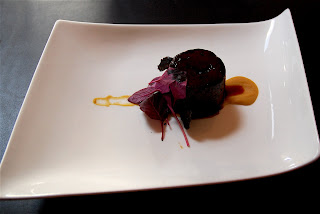
The actual appetizers kicked off with a timbal de tomate con helado de mozarella, tomato timbal with mozarella ice cream over baby greens. The mozarella ice cream was a revelation. The timbal was followed in short order by appetizers that Felipe and I had selected--his, an out of this world cream of morel soup; mine, cigalas (crayfish). The crayfish centres were served over peas and flowers in a citrus salsa; the legs were served on the side. The crayfish experience was rounded out by a fragrant bisque in a porcelain cup, to be sipped at the end. Amazing.

The mains were no less impressive. Felipe's rabo de buey (pictured above) in an elegant red wine reduction was rich and satisfying; my bacon wrapped monkfish over steamed vegetables and beetroot chips equally so.

We were both already tingling with pleasure by the time the desserts arrived, a platter of golosinas (childhood sweets), which would have tickled the fancy of any 7 year old and which left us giggling and excited. There were tiny servings of sugared raspberries and blueberries reminiscent of hard drugstore candy; amusement park ices in coca cola, coconut and strawberry; cloud like cotton candy wisps; decadent coconut marshmallows tinged with chocolate; a coy sunflower brittle; stray pieces of caramel corn; and even a wry piece of black licorice, oddly bearable in comparison with the black licorice whips I so hated as a kid.

We would have left happy after these, but there was more: a refreshing lemon and mango icecream with frozen raspberry and blueberry jelly and, finally, white and milk chocolate with coffee.

We walked out of Moo feeling like we'd eaten like kings for a relative pittance, the bill--for a feast that included the menus, two cavas, two glasses of wine and coffee--came to not a penny more than 90 euros, as promised, and I'm pretty sure that I didn't touch another piece of food for the rest of the day.

More recently, we treated ourselves to the menu at Arola (pictured, right, www.arola-arts.com), Sergi Arola's outpost at the tony Arts Hotel in the Olympic Port. (It should be noted that Arola is not on location here at all times, working mostly out of his restaurants in Madrid). At 32 euros, the menu includes four courses and bread--all beverages are extra and can rapidly add up to more than the 32 per person of the menu itself. While they claim not to take reservations for the terrace, they did set aside a shady terrace table for us. Their policy is to try to accommodate you if possible and they seem to have plenty of room to do so--I would say that you could even chance it without reservations.

We were greeted with a creamy basil spread with crisps as an aperitif, followed by a traditionally served pan con tomate--that is to say, toasted bread, olive oil, salt, whole tomatoes and whole cloves of garlic. The expectation, of course, is that you make your own (rub the bread with the garlic and tomato (both of which you must cut open), then drizzle with olive oil and sprinkle with salt...it's a pleasantly interactive part of the meal, but one that would be helped greatly by a more suitable knife and better bread.

The appetizers, for sharing, came next: signature patatas bravas--tiny cones of potato, filled with hot sauce and topped with creamy mayonnaise (pictured at the top)--that are perfection in both flavour and texture and possibly the best version of bravas that I have tasted; and a rather simple salad of cold, steamed baby vegetables topped with iberico ham.

The star attractions were a delicate hake in light green sauce--the green, we discovered, were peas, parsley and garlic--and a black rice with sepia (pictured, left); you have your choice of one of the two and both were flawlessly executed and generous, though Felipe complained that he could have eaten more rice (the man generally eats for two or three, however, so take it with a grain of salt).

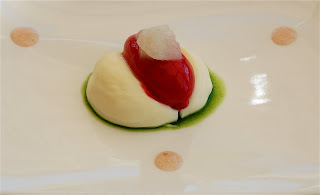
Dessert was lovely: a white chocolate cream topped with an explosive raspberry sorbet, rose jelly and lychee (pictured, left). A second dessert of petit fours (chocolate-banana flakes, coconut macaroons, lemon madeleines and marshmallows) followed with coffee.

After four glasses of wine, a bottle of fashionable water and a cortado (espresso with milk), our bill came to 115 euros. Not bad value, but Moo delivered much more for less.
By way of final notes, the service at both restaurants is generally young and a tiny bit stiff, particularly at Moo, but really that's nitpicking. Both places have a tranquil, modern vibe and the terrace at Arola, with its herb and vegetable planters and view of the tail of Frank Ghery's sparkling fish, is unbeatable. The pillowy sofas alongside the terrace are the perfect place to sip your coffee or a digestif and would be a wonderful spot to while away a breezy evening.

A footnote to this post is the Eixample's Noti (noti-universal.com), which for a long time has had a 20 euro menu del día, a three course affair that is both competent and tasty, but rather on the small side and in no way on par with the elaborate culinary hijinks at Moo and Arola.

Friday, June 5, 2009

Tapas Menu -Take 1

It's a summer Saturday. Heat ripples the air, there's barely a breeze, and you're still slightly smarting from the revelry of the night before. You'd crawl into your hammock, if you had one, and spend the rest of the day sipping cool, life-giving water through a bendy straw under the shade of the lone tree in your back yard. If only you could. As it happens, you're expecting your in-laws for lunch.

This is a scenario that clearly calls for Tapas Menu Number 1:

Navajas a la plancha (grilled razor clams)
Langostinos a la plancha (grilled prawns)
Surtido de quesos y embutidos (selection of cheeses and cured meats)
Pan y aceitunas (bread and olives)

Assuming you have access to a good market, you're set. If you spend more than twenty minutes in the kitchen, something has gone horribly, horribly wrong.

To assemble this mini-feast, you should start by soaking the razor clams (you'll want at least 3 or 4 of these per person)...they're sandy and need to sit in warm water for about 10 minutes before you put them on the grill. You can also give the prawns (about 3/4 kilo or more, depending on how hungry you expect your in-laws to be) a rinse and shake them off in a colander.

For best results, you should get everything ready and on the table before you cook the seafood so that you can bring out the steaming platters of shrimp and clams as the crowning pièce de résistance. You should put out the olives and sliced bread along with a good extra virgin olive oil and salt. The cheese can go out sliced or whole, in the latter case with its own knife.

There's an enormous selection of Spanish cheese. One of the most popular varieties is manchego (pictured), a hard sheep's milk cheese from central Spain, which comes in fresco, semi-curado, curado y viejo varieties, a scale from youngest (softest and mildest) to oldest (hardest and sharpest). Another favourite is idiazabal, a yellow sheep's milk cheese from the Basque country. Other delicious goat, cow and sheep's milk cheeses abound in Spain and each region usually has a specialty or two. You should ask at your cheese shop about the different varieties and don't feel the need to limit yourself to just one.

The cured meats should go out sliced. Jamón iberico (pictured) or the much less expensive jamón serrano should be sliced paper thin at the shop. Embutidos (sausages) such as chorizo, fuet, longaniza or morcón (pictured) can be hand sliced at home. Chorizo and morcón (a larger, more coarsely cut version of chorizo) are flavoured with paprika and may be purchased in mild to spicy versions. They provide a nice counterpoint to the slightly sweet jamón iberico. Fuet and longaniza are also good choices--they have a subtle, slightly peppery flavour.

Now that the cured meats and cheeses have been taken care of, you can turn your mind to the seafood. Remove the clams from the warm water in which they've been soaking and give them another rinse under cold water. Set aside to wait with the shrimp.

Heat about a tablespoon or two of olive oil in a large frying pan, preferably one with a lid. Once the oil is hot, add a few slivers of garlic for flavour, stir for a moment and add the prawns. Sautee on medium high heat for a 3-4 minutes until the prawns have just turned a bright pink on all sides and not a second longer. (For more about cooking prawns, see The Tapas Episode.) Remove to a warm plate, clean out any obvious shell residue with a paper towel, add a little more oil to the pan and the razor clams. Cover with the lid. The clams only need about two to three minutes on the grill at medium-high heat, but you should turn them once (with tongs is easiest). Be careful of the sputtering oil and water combination. I might also have garnished the razor clams pictured above with a teaspoon of finely chopped thyme and about the same quantity of chopped, sauteed garlic, but this is absolutely not necessary--if you want to, though, you can throw these ingredients into the frying pan for a few seconds before you put in the razor clams. The clams should be completely open when you serve them. Feel free to serve with a little lemon on the side, but, again, absolutely not necessary when you have good, fresh seafood.

Bring the mouthwatering plates of seafood out with the appropriate pomp and ceremony and pour some cava (Catalan sparkling wine) all around. Your work is done.

Wednesday, June 3, 2009

June Is Tapas Month

You might remember that, some time ago, I promised to return to tapas, first addressed with the help of my saucy sous-chef, Stephen, in The Tapas Episode. I think it's been more than half a year since that promisory post, but tapas have been on my mind, not to mention in my belly, since then and I've taken some important steps to bring you more about tapas--primarily these were eating steps, interspersed with relatively random cooking, researching and photographing steps. As a result of these selfless efforts, I am now ready to usher in--I believe a drum roll is in order--Tapas Month.

Oh, the succulent treats and spicy bits of information that Tapas Month will offer! Oh, the delectable photo spreads! Oh, the trusty recipes! Oh, the coveted tapas bar recommendations! Oh, if only you could trust me to deliver. Ahem.

Well, deliver I will! And, as an amuse bouche of good faith, I'm going to first serve up some juicy tapas trivia. Well, maybe not that juicy. Actually, probably just this side of dry. Still, the point is that I'm making an effort. An effort you might look upon kindly next time you're on the verge of taking me off your reading list after an embarrassingly long absence of posts.

There is a problem with tapas in Barcelona about which you may not know. Tapas, despite their near ubiquity in the city, are not really a Barcelona thing. Sort of like churros. Despite the fact that you can get them, Spaniards will tell you that they're not really as they should be.

What does it mean to be so prevalent and still not to be a "Barcelona thing"? Well, for one, the tapas tradition--that of accompanying an afternoon or evening drink with a small serving of food--really arose south of here. In parts of southern and central Spain many bars serve a free tapa or two with the purchase of a drink, such that the "tapeo", or going from bar to bar sampling tapas and drinking your face off, is sort of like a regional sport. The only bar that I know of that upholds this tradition in Barcelona--only occasionally and sometimes only if you look like something of a local, which apparently sometimes I do and sometimes I don't--is De Tapa Madre (c/Mallorca 301, www.detapamadre.com), a dependable spot in the Eixample. The rest often charge an arm and a leg for the small tidbits that some southerners consider to be their rightful due with the purchase of an alcoholic beverage. This is what Spaniards really mean when they say that tapas aren't a Barcelona thing--they're not free; they're not even cheap. (One of the exceptions to the "not cheap" rule is El Xampanyet in the Born, pictured above and to be discussed in another post.)

That said, there are many excellent tapas bars in Barcelona and, if one looks at expense issue from another perspective, Barcelona is probably one of the best spots in Spain to sample some high quality, highly inventive, highly eclectic tapas. More on that later.

For today, I will leave you with this slightly unappetizing thought: The word tapa (from the verb "tapar", literally to cover) is thought to have evolved from the centuries old practice of using a piece of bread or cured ham to cover glasses of wine in bars in order to prevent flies or dust from falling in. Happily, we currently live in more hygienic times and your ham is now (usually) served on a plate.

Friday, May 22, 2009

A Picnic in Heaven

Heaven, I'm in heaven

And my heart beats so that I can hardly speak

And I seem to find the happiness I seek

...


And then, of course, there's the "cheek to cheek" business of the Irving Berlin classic, but I never get to that part when I'm singing the song in my head these days. "I'm in heaven" is on a permanent loop.

Indeed, heaven is the luscious slice of bliss that is currently Barcelona: cotton candy cumuli bobbing on periwinkle skies, whispering oak canopies shading the grand boulevards, terrace gardens erupting in flower, choirs of birds singing the city awake, a heat that hasn't lost its kindness, and a slight breeze ruffling the scarves that cling stubbornly to Barcelona necks despite forecasts of a balmy 25C. It's the kind of ephemeral perfection that leaves one wandering the city in a bemused trance hoping that the reverie never ends.

Actually, the best part is that it's only just beginning. Tourist invasion aside, spring and summer in Barcelona are an absolute wonder and, whether you're a hardened Barcelona resident or a wide eyed visitor, I recommend celebrating their glory with a picnic.

Your picnic need not be elaborate. You can make do with a couple of sandwiches and a bottle of wine or maybe even a cava if you're hoping to get lucky. Throw in a brownie or a punnet of strawberries or perhaps both and you have a veritable feast. All you need to worry about is the blanket as I'm about to take care of the rest.

In terms of ready-made picnic supplies, Barcelona abounds with bakeries and food shops to cater to your every need. In a pinch, try the sandwiches and cakes at the Eixample's Mauri Pastelería (www.pasteleriasmauri.com, tarts and croquettes of all kinds are a particular treat)) or at Garriga (c/ Consell de Cent 308, tel. 932 157 215, the plum cake (in Spanish, "ploom cake") is particularly delicious); more elaborate take away plates and generous American style desserts at Born Cooking (www.borncooking.com, excellent if you're missing carrot cake or chocolate chip cookies); a variety of ready made dishes, including traditional favourites, at Pim Pam Plats and its sister restaurant Pim Pam Burger in the Born (pimpamplats.com); delectable baked goods at the recently opened Atlanta bakery (c/Princesa, just off of Via Laietana, beware of the baffling lack of reasonable take away containers, particularly as there's nowhere to eat inside) [NOTE 17-08-2009: Atlanta closed as rapidly as it opened; in its place, and under the same name, you can now find a women's clothing store]; wine and just about any canned product at the Eixample's Colmado Quilez (Rambla Catalunya 63, tel. 932 158 78; in a nod to old timey redundancy, get the cashier to total your purchase, take the receipt to the woman at the door to pay and return with the stamped receipt to pick up your purchase from the cashier); and, if you're feeling a little more hands on and up for adventure, anything and everything at the spectacular Boquería Market (www.boqueria.info).

Ferreting out the perfect location is also a breeze these days. Some of the best picnic spots in Barcelona can be found on the steamy beaches with their buzzing boardwalks and chiringuitos (venture past Barceloneta and Puerto Olympico for fewer American teenagers); on the shady slopes of Montjuic--best experienced while watching an outdoor movie with your picnic dinner (check out www.salamontjuic.com for this summer's movie schedule, screenings start June 29 and continue to the end of July); amid Ciutadella Park's tree-lined hive of activity, whether during a concert (the Musica Classica als Parcs concert series is scheduled for Thursdays and Fridays at 10pm in Ciutadella and Turo Parks between July 2 and 24, 2009) or an impromptu juggling rehearsal; within the idyl of Gaudi's Parque Guell (brave the crowds at the entrance and on the fabulous tiled terrace and make your way to the rustic aqueducts lined with alcove benches); and, if you're in the mood for a subway ride (Mundet or Valldaura metro stops on the Green Line (L3)), lost in the childish pleasure of the the living labyrinth in the Parque del Laberinto de Horta. For more information about Barcelona parks, gardens and beaches check out the Parks and Gardens portion of the City's website at www.bcn.es/parcsijardins.

Oh, and one more thing, if you're lovers, or maybe even if you're not, take along a book of the now deceased Mario Benedetti's poems, as Felipe and I did this week, and select a few to read out loud over a glass of wine on the grass.

Friday, May 1, 2009

The Charred and the Seedless (Escalivada)


By way of adding to your tapas repertoire, I'm going to tell you about escalivada. And, yes, this too is inspired by Jordi and Deirdre's calçotada, which featured deliciousness far beyond mere calçots.

The word escalivada comes from the Catalan verb escalivar, which means to roast over hot embers or, in the approximate language of today's world, char grill. A true escalivada, which has peasant and country roots, involves placing whole unwashed vegetables (generally, eggplants, peppers and tomatoes) into an open fire (or, better yet, hot ashes) to roast--as in the photo above--, then peeling and serving them with a sprinkling of oil and salt. This of course requires access to an open fire, which I will assume most of the readers of this blog don't readily have.

Fortunately, an open fire is not absolutely necessary to make a slightly less authentic version of the beloved salad, a version that is easy peasy and open to fiddling and interpretation. I, for one, often dispense with everything but the eggplant, peppers, tomatoes and salt (particularly when I'm feeling an excess of weight in the thigh region) and use quantities of vegetables that reflect what's readily available in my fridge rather than exact amounts. Please use what follows more as a spiritual guide than as biblical escalivada truth.

Ingredients

2 large or 4 small eggplants
4 red peppers
4 tomatoes
1 onion (optional)
2 cloves of garlic (optional)
1 tsp finely chopped parsley (optional)
olive oil, salt and pepper (to taste)

Preparation

Preheat the oven to 220 degrees C. Slice the eggplants in half and set aside for half an hour sprinkled with salt to remove the bitter juices. In the meantime, cut the peppers in half, remove seeds and place cut side down on a baking sheet lined with oiled aluminum foil. If you are using onion (I don't), place it--sliced in half, drizzled with olive oil and wrapped in aluminum foil--in the oven with the peppers. Roast for about 30 minutes or until the skin of the peppers has blackened and is coming away from the surface. Remove and set aside. Roast the eggplant in the same way once you have rinsed off the salt and dried each piece. Slice the tomatoes in half and roast for about 15-20 minutes--if you have room, you can slide the tomatoes in with the eggplant about 10-15 minutes into the eggplant's roasting time. Remove the skin from the roasted vegetables, slice into strips and combine in a serving bowl, being sure to include the juices. Dress with salt and pepper, the minced garlic and a little olive oil. (Leave out the garlic and oil for a lighter salad and, if so inclined, sprinkle in some finely chopped parsley.)

As for final touches, I often top escalivada with a soft Catalan goat cheese. I place the escalivada in an oven proof container, cover with large slices of goat cheese and brown under the broiler for a couple of minutes or until the cheese is golden. This version--as well as the cheeseless one--is delicious as part of a meal of tapas or alongside any meat dish.

Another common way to serve is on toasted bread topped with good quality anchovies and, if you like, olives.

Come to think of it, the always packed Cerveceria Catalana (c/ Mallorca 236 (Eixample), 93 216 0368) has terrific examples of both versions for those who'd rather forego the cooking altogether.

Thursday, April 30, 2009

Salsa Romesco


It's rare that I deliver on my gratuitous on-line promises, but today is an exception. I've had the recipe for an unbelievable salsa romesco on my hands for some time and it seems a profound transgression not to share it. Not only is it straight from Tarragona--cradle of the romesco sauce and charming Roman town just an hour outside of Barcelona--, it's also a tried and true family recipe, courtesy of Mrs. Fernández Roig, a.k.a. Jordi's mom, who prepared it for a crowd of hungry calçot eaters earlier this spring. See the Calçotada post for details.

You may not know a lot about salsa romesco; it doesn't have the international caché of an allioli or a bernaise, but it does have the chops and is a Catalan favourite. It's sweet, it's savoury, it's smooth, it's crunchy and, while it goes with almost anything (I was spreading it liberally on toasted bread recently), it's most commonly served with roasted vegetables, including calçots, as well as fish and seafood.

The base, in addition to ground nuts and olive oil, contains a type of pepper that is difficult to find outside of Spain. The traditional peppers used are often referred to as "romesco peppers" and can easily be found in Catalunya; they are distinct from ñora peppers which are often also used. These peppers are smaller than your average red pepper and have a richness that a regular capsicum does not. Outside of Spain, red bell peppers can be substituted, but I'm afraid the substitution, if not exactly second rate, makes the salsa more of a romesco "lite".

Now, here is the recipe, just as it was provided to me--with translation and some explanation. I must say I had to guess regarding the quantities of pimentón, olive oil, and vinegar, but that is the beauty of a family recipe.

Ingredients

125 gr toasted almonds
125 gr toasted hazelnuts
50 gr pine nuts
2 walnuts
1 onion
8 tomatoes
1/2 head garlic
5 dried "romesco" peppers
a tiny bit of raw garlic, pressed (to taste)
a tiny bit of sugar (to taste)
1 tsp spicy pimentón (or hot paprika)
about a cup of olive oil
about half a cup of red wine vinegar
salt (to taste)
cayenne pepper (to taste; optional and not part of Jordi's mom's recipe)

Preparation

Char grill the onion, tomatoes, garlic and blanch the peppers (if using fresh peppers, char grill these too). (If you are Jordi's mom, you will do the char grilling over a wood fire in the outdoor brick oven in your backyard; if you are not, you will likely have to do with your home oven at about 220 degrees C for 30 minutes or so.) Once the vegetables have cooled sufficiently, remove the skin. You will now have to use a food processor unless you have freakishly strong arms and a giant mortar and pestle. Start with the nuts; add the vegetables and seasonings next; and finish things off with the olive oil, added slowly in a thin stream to ensure the sauce holds together (some add a bit of toasted bread to the mix to help with the consistency). Process until well mixed but not completely smooth. Add vinegar and salt to taste at the very end.

By the way, to be completely authentic, you should buy your olive oil and hazelnuts in Constanti, the town where Jordi's mom was born.

This recipe will serve ten, so prepare to share.

Friday, April 17, 2009

Calçotada


Well, I have sunk to such depths of delinquency this time that readers have taken to emailing me to ask if they should remove my inactive blog from their reading list. Please let me take this opportunity to assure you that I have not drifted off to eternal sleep; I've just been hibernating. And, as spring is fully swinging here in Barcelona, the time is more than apt to come out of my cave, if only to blink dazedly and crawl back in for another snooze.

Since I'm out here now, let me remedy my long standing failure to post the calçotada link I promised (go ahead and click on it now): Feting the humble onion in Catalonia. The article came out in the Globe & Mail in March and I must thank my friends Jordi and Deirdre for supplying the culinary and literary fodder for the piece and the 2-3 extra pounds I put on in the single day of feasting.

I should also mention that the calçots we ate that day were accompanied by a fabulous salsa romesco prepared by Jordi's mom, a master of this sweet and spicy traditional sauce. She was kind enough to provide me with her recipe, which (at the risk of once more making promises I may not keep) I will post here shortly.

For those looking for an authentic calçotada experience near Barcelona, the article contains a couple of restaurant recommendations. However, we are at the very, very end of calçot season and you may need to wait until next year to get down with the onion in true Catalan style.

Monday, December 1, 2008

The Weather Outside is Frightful


It's blustery and cold here in the Ciudad de Condal. The waves breaking on Barceloneta beach are impressive, as are the few surfers brave or crazy enough to venture in with their boards. Felipe and I are content to watch them, huddled into our coats and scarves, warming our hands on hot chestnuts if we can still find them.

We've been going out for long walks as often as we can on these frigid days--a sort of boot camp for our winter holidays in Canada. The unfortunate truth--and one I haven't yet let Felipe in on--is that a blustery day in Barcelona has nothing on a Canadian winter. I'm trying to break it to him gently, shall we say.

Our night walks are now lit by Barcelona's myriad constellations of Christmas lights and, by day, we often pass through the cathedral square, where the Fira de Santa Llucia (www.firesifestes.com), with its gaudy holiday baubles and fragrant greenery, opened this weekend. Only the creche in Plaza de Sant Jaume remains a secret, though not one that's very well kept: you get a pretty good idea of the state of things by surreptitiously peeking through the green netting.

These are the last days of chestnut season--the few Castanyada shacks that haven't yet closed for business will likely do so in the next few weeks or so--and the early days of turrones and other Christmas sweets. If you're keen, you can read about the latter here: No Ordinary Nougat, Peladillas, and The Dustiest of Desserts.

All in all, a wonderful time to be in Barcelona, despite the cold.